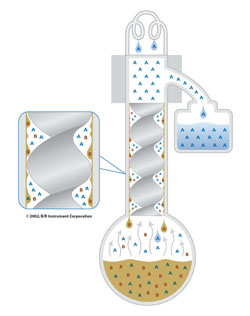
High-plate columns for close-boiling separations, from 5 mL analytical samples through 50 L production batches.
A helical band rotates inside the distillation column, wiping the inner wall and continuously renewing a thin film of liquid against rising vapour. That intimate contact is what produces plates: the same column that would give a handful of stages packed gives up to fifty when the band is spinning.
Two consequences follow. Hold-up stays under 5 mL, so very little of a valuable sample is lost inside the column — and close-boiling components that a simple still smears together come off as distinct fractions.
Because the plates come from motion rather than column height, the whole separation happens in a short column at low pressure drop, which is what makes the technique workable on heat-sensitive material.
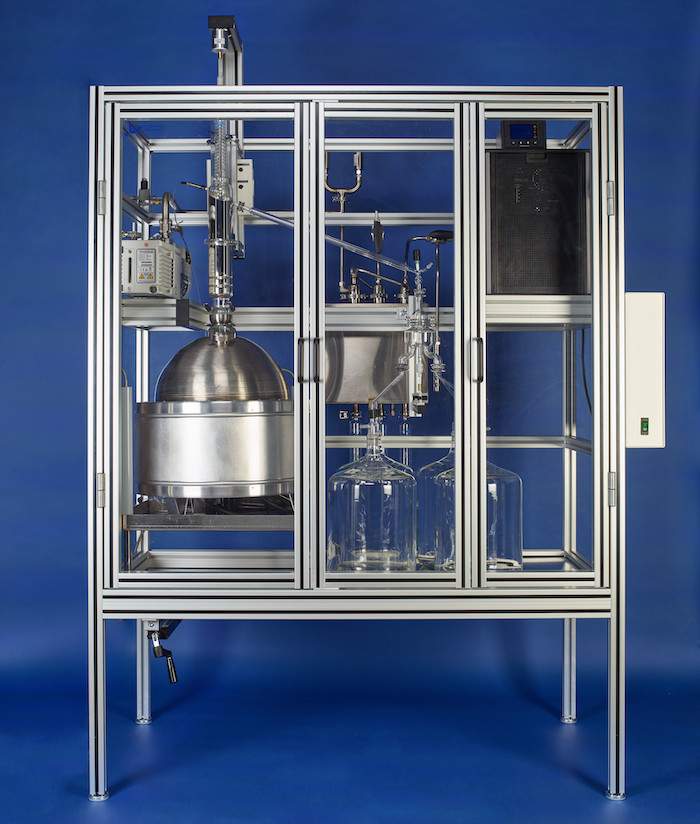
All three use the same spinning band principle. They differ in charge size and in how much separating power is packed into the column.
| System | Charge range | Separating power | Control | Typical use |
|---|---|---|---|---|
| 9600 Spinning Band | 1–50 L | Baseline | Automatic controller | Lab through production across a wide range of samples |
| 36-100 Mini | 25 mL – 1 L | 4× the 9600 | Automatic or manual | Smaller charges needing more plates |
| 800 Micro | 5–25 mL | Maximum | Manual | Analytical and research samples |
Purification and separation of essential oil compounds.
Distillation and analysis of crude oil and petroleum samples.
Purification and separation of close-boiling chemical mixtures.
Sample preparation and analysis for environmental testing.
| Flask sizes | 5 mL to 50 L |
|---|---|
| Theoretical plates | Up to 50 |
| Column hold-up | Under 5 mL |
| Reflux ratio | Programmable, 0:1 to 999:1 |
|---|---|
| Teflon bands | Below 225 °C |
| Metal bands | Higher temperature applications |
Talk with a B/R applications specialist about spinning band systems and process fit for your crude.
Request a quote